
|
BIOHAZARD UMBRELLA CHRONICLES ART OF ARTS
(バイオハザード アンブレラ・クロニクルズ アート・オブ・アーツ) |
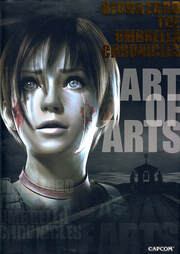
Released: 20/02/2008
Softcover: 125 Publisher: CAPCOM ISBN-10: 4862331726 ISBN-13: 9784862331724 |
Umbrella's Path (p.008)
In 1967, prestigious European aristocrat Oswell E. Spencer, his friend Edward Ashford, virologist Dr. James Marcus and others, discovered a virus which mutates cells, known as "Progenitor."
The following year, Spencer established the "Umbrella" corporation under the pretext of "protecting the health of the people." It was ostensibly a predominant pharmaceutical company, but in reality that was camouflage for virus research and raising funds for it. Ironically, beginning from the U.S. Raccoon City, it achieved massive growth and became a huge multinational enterprise known the world over. At the same time, Dr. Marcus was studying and improving the virus at the executive training school. A year after Albert Wesker, William Birkin and other talented executive trainees joined, the "t-Virus" was finally completed. While Spencer's influence increased, Marcus attempted to use this discovery to gain power once more, but Spencer shut down the executive training school as if to obstruct him. The base of the research was moved to the Arklay Laboratory, the so-called "Mansion." Afterwards, Marcus continued studying it in the training school, but was attacked and died at the hands of Wesker, whom he trusted.
In the Arklay Laboratory, William took over t-Virus research, replacing Marcus, and created the "Tyrant", the ultimate living organism B.O.W. Construction of a huge underground laboratory eventually began in Raccoon City while development of the intelligent "Nemesis" commenced in the European Sixth Laboratory. Umbrella's rapid progress looked like it would continue, but in 1998, a rip in the umbrella was finally laid bare. A virus outbreak. The Arklay Laboratory was struck by a biohazard and totally destroyed, and the rampaging Marcus also caused a worst case scenario inside the executive training school. These were the "Mansion Incident" and "Ecliptic Express Incident." In the same year, while William conducted research in the underground laboratory, he completed a more powerful virus, the "G-Virus". William schemed to monopolize this but it was stolen by Umbrella's special forces. The t-Virus stored in the lab leaked by that stage, plunging Raccoon City into utter ruin.
The horrifying virus spread into the city in the blink of an eye. The U.S. Government had been colluding with the merchant of death Umbrella and decided upon dropping a missile into Raccoon City in an effort to annihilate evidence of this. The "Sterilization Strategy" was executed to erase everything, wiping the city's name off the map. The following year as well, with growing criticism from public opinion on the most colossal catastrophe since the beginning of recorded history, the U.S. Government issued an order against Umbrella to cease operations indefinitely.
However, the nightmare wasn't over. A scenario for Umbrella's revival was underway at an underground laboratory based in Russia, funded by a dummy company of Umbrella. The company executive Sergei Vladimir spearheaded the plan. Under Spencer, he strove to revive the company and his motherland and took possession of the supercomputer "U.M.F.-013" containing all of Umbrella's data, as well as confidential data capable of controlling the world, but he was tragically foiled. The Russian branch was destroyed. There, was the figure of a man who had repeatedly worked behind the scenes and had at last stolen all the data. His name was Albert Wesker.
Albert Wesker (p.009)
Behind the scenes of Umbrella lurked the visage of Wesker. One must wonder why he'd betray Umbrella and lead it to collapse with meticulous scheming---
In 1977, Wesker was assigned as an executive candidate to the executive training school alongside William Birkin. He continued research working under Spencer, but harbored doubts concerning his goal and ways of thinking. Then 11 years later in 1988, he killed his teacher Dr. James Marcus at Spencer's command. He had the calm, cruel personality and lack of hesitation appropriate for this crime. He used human lives to push his way up the ladder. At the moment of the assassination, though he repudiated Spencer's philosophy, he may have perceived himself as of the same ilk. Whilst virus research and development saw progress in William's hands, he decided to transfer to the intelligence division. Using various secrets, he resolved to become an absolute ruler in a different manner from Spencer. It was at this point he began working behind the scenes.
When the Raccoon Police Department's special ops unit "S.T.A.R.S." was formed, he was appointed Captain through the intervention of Umbrella, a significant contributor of funding. While he was drawing blueprints for consolidating a quid pro quo position by providing information to an opposing company, an opportunity revealed itself to him. It was the Mansion Incident. He guided the officers into the biohazard-struck Arklay Laboratory, taking advantage of the chaos to provide combat data with live humans, and was even willing to offer the Tyrant as well. On this occasion, Wesker heard information on resurrection from William beforehand and injected himself with a virus, letting the Tyrant attack him. Though his desperate human experiment succeeded, Sergei blocked his access to the data and the Tyrant vanished at the hands of Chris and Jill. He'd completely severed ties with Umbrella and his plan had ended in failure.
After moving to the opposing company, Wesker promptly put his next scenario into action. This was to seize the G-Virus developed by William. At one stage it came to a standstill due to Umbrella's interference but was brought to light by a female spy on his company's side. A tissue fragment was successfully recovered. In this manner, Wesker's power grew in the new world.
Raccoon City was destroyed and before long, Umbrella collapsed. The opposing company's prosperity put an end to Umbrella, yet Wesker had obtained secret data and stolen the foothold to a revival.
After causing Spencer to lose his position, his frightening scenario continues.
GLOSSARY
Arklay Laboratory
A top-secret Umbrella laboratory constructed in Arklay's forest area. It's ostensibly merely a mansion, but various traps were placed and invasion from outside is nearly impossible. A virus leaked causing a serious biohazard, and it was destroyed.
Umbrella Executive Training School
A facility for raising Umbrella personnel, built in close proximity to the Arklay Laboratory. The first director was James Marcus. With his mad research, most of the staff became guinea pigs for experiments.
Umbrella Security Service
A military unit organized by Umbrella executives along with the Supervisors. In contrast with the U.B.C.S., it's a darkside of Umbrella that conducts covert tactical ops. It assembles a small number of elites and HUNK, known as the Grim Reaper, belongs to Alpha Team.
Supervisors
A covert surveillance organization under the direct command of Umbrella executives. For significant fees they mainly observe within the company, but also conduct missions such as assassination and destroying evidence. Nikolai Zinoviev's one of them and Sergei Vladimir commands them.
U.B.C.S.
The Umbrella Biohazard Countermeasure Service. A private military unit of Umbrella, when a biohazard's caused by the company's products, it implements life-saving strategies. Carlos Oliveira belongs to it.
Sterilization Strategy
A strategy for completely eradicating Raccoon City to stem the tide of the t-Virus spreading to the outskirts. 100,000 citizens lost their lives this way. It was a strategy for the U.S. Government to destroy evidence implicating their collusive relationship with Umbrella.
Raccoon City
A city located in the midwestern United States. After courting Umbrella, a wave of industrialization surged and it rapidly developed. About 30% of the population is engaged in Umbrella-related occupations.
R.P.D.
Raccoon Police Department. The chief Brian colluded with Umbrella. Brian's incoherent orders caused the force to collapse when virus infection began in Raccoon.
S.T.A.R.S.
The Special Tactics and Rescue Service under the jurisdiction of the Raccoon City Police, consisting of Alpha and Bravo teams. The Captain was Wesker. It vanished with Raccoon City's destruction.
B.O.W.
Abbreviation of Bio Organic Weapon. Meaning organic life-form weapons Umbrella administered with the t-Virus for weapon product development. Other than the development of large B.O.W. models mainly involving combat, there are also plans such as dispersal weapons for spreading infection.
t-Virus
A virus which improved the Progenitor Virus with emphasis on military application. "t" is an acronym for Tyrant. Absorption has the effect of making a target creature become ferocious. In addition, contact with an infected subject causes secondary infection.
G-Virus
A new virus William Birkin developed. Unlike the t-Virus which causes mutations within a single generation, once infected with this, the G-Cells replicate and produce new G-Organisms. The form Birkin inflicted on himself to turn into a monster is called "G-Birkin."
Chronological Table (p.010-011)
1967
The organism-modifying "Progenitor Virus" is discovered.
1968
The pharmaceutical company Umbrella's founded.
'68
Umbrella establishes an executive training school, Dr. Marcus is first director.
1977
Executive candidates Wesker and William are assigned to the training school.
1978
Dr. Marcus successfully develops the t-Virus.
'78
The executive training school's shut down, t-Virus research moves to the Arklay Laboratory.
1988
Wesker and Birkin assassinate Dr. Marcus.
'88
The "t-Virus Project" develops the ultimate life-form B.O.W. Tyrant.
1991
The Umbrella Underground Research Facility's constructed in Raccoon City.
'91
The Umbrella Europe Sixth Laboratory commences the "Nemesis Project."
'91
Spencer approves William's "G-Virus Project."
'91
Wesker transfers to the intelligence division.
1996
S.T.A.R.S. is founded under Raccoon City's jurisdiction, Wesker's inaugurated as Captain.
1999
The U.S. Government issues Umbrella a business suspension order, the company incurs much damage.
2003
The Umbrella Russia Branch is destroyed by a private anti-biohazard unit.
In 1967, prestigious European aristocrat Oswell E. Spencer, his friend Edward Ashford, virologist Dr. James Marcus and others, discovered a virus which mutates cells, known as "Progenitor."
The following year, Spencer established the "Umbrella" corporation under the pretext of "protecting the health of the people." It was ostensibly a predominant pharmaceutical company, but in reality that was camouflage for virus research and raising funds for it. Ironically, beginning from the U.S. Raccoon City, it achieved massive growth and became a huge multinational enterprise known the world over. At the same time, Dr. Marcus was studying and improving the virus at the executive training school. A year after Albert Wesker, William Birkin and other talented executive trainees joined, the "t-Virus" was finally completed. While Spencer's influence increased, Marcus attempted to use this discovery to gain power once more, but Spencer shut down the executive training school as if to obstruct him. The base of the research was moved to the Arklay Laboratory, the so-called "Mansion." Afterwards, Marcus continued studying it in the training school, but was attacked and died at the hands of Wesker, whom he trusted.
In the Arklay Laboratory, William took over t-Virus research, replacing Marcus, and created the "Tyrant", the ultimate living organism B.O.W. Construction of a huge underground laboratory eventually began in Raccoon City while development of the intelligent "Nemesis" commenced in the European Sixth Laboratory. Umbrella's rapid progress looked like it would continue, but in 1998, a rip in the umbrella was finally laid bare. A virus outbreak. The Arklay Laboratory was struck by a biohazard and totally destroyed, and the rampaging Marcus also caused a worst case scenario inside the executive training school. These were the "Mansion Incident" and "Ecliptic Express Incident." In the same year, while William conducted research in the underground laboratory, he completed a more powerful virus, the "G-Virus". William schemed to monopolize this but it was stolen by Umbrella's special forces. The t-Virus stored in the lab leaked by that stage, plunging Raccoon City into utter ruin.
The horrifying virus spread into the city in the blink of an eye. The U.S. Government had been colluding with the merchant of death Umbrella and decided upon dropping a missile into Raccoon City in an effort to annihilate evidence of this. The "Sterilization Strategy" was executed to erase everything, wiping the city's name off the map. The following year as well, with growing criticism from public opinion on the most colossal catastrophe since the beginning of recorded history, the U.S. Government issued an order against Umbrella to cease operations indefinitely.
However, the nightmare wasn't over. A scenario for Umbrella's revival was underway at an underground laboratory based in Russia, funded by a dummy company of Umbrella. The company executive Sergei Vladimir spearheaded the plan. Under Spencer, he strove to revive the company and his motherland and took possession of the supercomputer "U.M.F.-013" containing all of Umbrella's data, as well as confidential data capable of controlling the world, but he was tragically foiled. The Russian branch was destroyed. There, was the figure of a man who had repeatedly worked behind the scenes and had at last stolen all the data. His name was Albert Wesker.
Albert Wesker (p.009)
Behind the scenes of Umbrella lurked the visage of Wesker. One must wonder why he'd betray Umbrella and lead it to collapse with meticulous scheming---
In 1977, Wesker was assigned as an executive candidate to the executive training school alongside William Birkin. He continued research working under Spencer, but harbored doubts concerning his goal and ways of thinking. Then 11 years later in 1988, he killed his teacher Dr. James Marcus at Spencer's command. He had the calm, cruel personality and lack of hesitation appropriate for this crime. He used human lives to push his way up the ladder. At the moment of the assassination, though he repudiated Spencer's philosophy, he may have perceived himself as of the same ilk. Whilst virus research and development saw progress in William's hands, he decided to transfer to the intelligence division. Using various secrets, he resolved to become an absolute ruler in a different manner from Spencer. It was at this point he began working behind the scenes.
When the Raccoon Police Department's special ops unit "S.T.A.R.S." was formed, he was appointed Captain through the intervention of Umbrella, a significant contributor of funding. While he was drawing blueprints for consolidating a quid pro quo position by providing information to an opposing company, an opportunity revealed itself to him. It was the Mansion Incident. He guided the officers into the biohazard-struck Arklay Laboratory, taking advantage of the chaos to provide combat data with live humans, and was even willing to offer the Tyrant as well. On this occasion, Wesker heard information on resurrection from William beforehand and injected himself with a virus, letting the Tyrant attack him. Though his desperate human experiment succeeded, Sergei blocked his access to the data and the Tyrant vanished at the hands of Chris and Jill. He'd completely severed ties with Umbrella and his plan had ended in failure.
After moving to the opposing company, Wesker promptly put his next scenario into action. This was to seize the G-Virus developed by William. At one stage it came to a standstill due to Umbrella's interference but was brought to light by a female spy on his company's side. A tissue fragment was successfully recovered. In this manner, Wesker's power grew in the new world.
Raccoon City was destroyed and before long, Umbrella collapsed. The opposing company's prosperity put an end to Umbrella, yet Wesker had obtained secret data and stolen the foothold to a revival.
After causing Spencer to lose his position, his frightening scenario continues.
GLOSSARY
Arklay Laboratory
A top-secret Umbrella laboratory constructed in Arklay's forest area. It's ostensibly merely a mansion, but various traps were placed and invasion from outside is nearly impossible. A virus leaked causing a serious biohazard, and it was destroyed.
Umbrella Executive Training School
A facility for raising Umbrella personnel, built in close proximity to the Arklay Laboratory. The first director was James Marcus. With his mad research, most of the staff became guinea pigs for experiments.
Umbrella Security Service
A military unit organized by Umbrella executives along with the Supervisors. In contrast with the U.B.C.S., it's a darkside of Umbrella that conducts covert tactical ops. It assembles a small number of elites and HUNK, known as the Grim Reaper, belongs to Alpha Team.
Supervisors
A covert surveillance organization under the direct command of Umbrella executives. For significant fees they mainly observe within the company, but also conduct missions such as assassination and destroying evidence. Nikolai Zinoviev's one of them and Sergei Vladimir commands them.
U.B.C.S.
The Umbrella Biohazard Countermeasure Service. A private military unit of Umbrella, when a biohazard's caused by the company's products, it implements life-saving strategies. Carlos Oliveira belongs to it.
Sterilization Strategy
A strategy for completely eradicating Raccoon City to stem the tide of the t-Virus spreading to the outskirts. 100,000 citizens lost their lives this way. It was a strategy for the U.S. Government to destroy evidence implicating their collusive relationship with Umbrella.
Raccoon City
A city located in the midwestern United States. After courting Umbrella, a wave of industrialization surged and it rapidly developed. About 30% of the population is engaged in Umbrella-related occupations.
R.P.D.
Raccoon Police Department. The chief Brian colluded with Umbrella. Brian's incoherent orders caused the force to collapse when virus infection began in Raccoon.
S.T.A.R.S.
The Special Tactics and Rescue Service under the jurisdiction of the Raccoon City Police, consisting of Alpha and Bravo teams. The Captain was Wesker. It vanished with Raccoon City's destruction.
B.O.W.
Abbreviation of Bio Organic Weapon. Meaning organic life-form weapons Umbrella administered with the t-Virus for weapon product development. Other than the development of large B.O.W. models mainly involving combat, there are also plans such as dispersal weapons for spreading infection.
t-Virus
A virus which improved the Progenitor Virus with emphasis on military application. "t" is an acronym for Tyrant. Absorption has the effect of making a target creature become ferocious. In addition, contact with an infected subject causes secondary infection.
G-Virus
A new virus William Birkin developed. Unlike the t-Virus which causes mutations within a single generation, once infected with this, the G-Cells replicate and produce new G-Organisms. The form Birkin inflicted on himself to turn into a monster is called "G-Birkin."
Chronological Table (p.010-011)
1967
The organism-modifying "Progenitor Virus" is discovered.
1968
The pharmaceutical company Umbrella's founded.
'68
Umbrella establishes an executive training school, Dr. Marcus is first director.
1977
Executive candidates Wesker and William are assigned to the training school.
1978
Dr. Marcus successfully develops the t-Virus.
'78
The executive training school's shut down, t-Virus research moves to the Arklay Laboratory.
1988
Wesker and Birkin assassinate Dr. Marcus.
'88
The "t-Virus Project" develops the ultimate life-form B.O.W. Tyrant.
1991
The Umbrella Underground Research Facility's constructed in Raccoon City.
'91
The Umbrella Europe Sixth Laboratory commences the "Nemesis Project."
'91
Spencer approves William's "G-Virus Project."
'91
Wesker transfers to the intelligence division.
1996
S.T.A.R.S. is founded under Raccoon City's jurisdiction, Wesker's inaugurated as Captain.
1999
The U.S. Government issues Umbrella a business suspension order, the company incurs much damage.
2003
The Umbrella Russia Branch is destroyed by a private anti-biohazard unit.
scenario:1 Train Derailment (p.017)
The Forest Where It Started
A helicopter crash-landed in the Arklay Mountains due to sudden engine trouble. The occupants were S.T.A.R.S. Bravo Team, who'd gone to investigate bizarre murder cases. After exiting the helicopter they discover a wrecked prisoner transport vehicle in the forest, along with the horrible condition of the Marines. The team disperses to search for the escapee and Rebecca Chambers discovers the Ecliptic Express train. The train's quiet... but the situation changes as Zombies attack her. Rebecca's saved at the last moment by former Marine Second Lieutenant Billy Coen. The heinous criminal who escaped.
With Rebecca's anxiety and suspicion swirling in her mind, the train quietly starts to move. Gradually the train speeds up abnormally, faster and faster, eventually overturning with a roar. The two survivors reach the Umbrella Executive Training School and immediately start searching the facility.
Ending the Nightmare
The director, James Marcus, who was supposed to be dead, appears in a treatment plant filled with countless leeches. He's been revived by the t-Virus after fusing with a leech's tissue. Marcus transforms into the Queen Leech and attacks Rebecca and Billy.
After a fight to the death, the two watch the training school go up in flames from a hilltop. "I have to go. My comrades are waiting for me." Rebecca removes the dog tags from Billy's neck, along with the charges against him. They salute each other, then go their separate ways.
Two Plots
A few hours earlier---. Two men in a monitor room watch Rebecca and Billy on their way to the training school. Umbrella intelligence agent Albert Wesker and researcher William Birkin. They'd been working on a plan to repurpose the training school, but they realized the plan was going to fail. As Wesker schemes to free himself of Umbrella, William's furious at him for the interruption to his research, blurting out a plan to blow up the training school.
A voice echoes through the tunnel. "Where might you be going? Comrade Albert Wesker." The voice belongs to an Umbrella executive, Sergei Vladimir. He unleashes Ivan against Wesker for failing in his Reclamation Project, but with a sudden flash and blast, Wesker vanishes. "Very well... We need to recover the Talos host first." With that, Sergei also left the scene.
scenario:2 Mansion Incident (p.018)
Invitation to Oblivion
In search of Bravo Team who disappeared in the forested region the night before, S.T.A.R.S. Alpha Team are suddenly attacked by bizarre creatures. The team attempts to retreat, but the mansion they take refuge in with Captain Wesker turns out to be a den of monsters. Chris Redfield and Jill Valentine start exploring the mansion, only to find themselves walking into Hell.
The Endless Fight
"Are you okay?" Rebecca awoke in a room in the mansion to the sound of Richard Aiken's voice. He found her sleeping, exhausted after escaping from the training school. The two of them start to move out as well. Constant fights with monsters that won't stop attacking them... As Rebecca's exhaustion reaches its limit, it mercilessly appears in front of her. A giant viper, so huge it obscured her vision. The moment its sharp fangs attack Rebecca, Richard takes a risk to save her and is mortally wounded. Rebecca's plunged into the depths of despair, but someone appears to light a beacon of hope. It's Chris and Jill.
The Truth Revealed
After leaving Rebecca and company, Chris and Jill are met in an underground incubation room by Wesker wielding a gun. He starts to tell the truth. He stands in front of the ultimate life-form, Tyrant, with an ecstatic expression on his face as he tells them about the bioweapons and his objective of obtaining combat data using the team members. The next moment however, the awakened Tyrant's sharp claws pierce Wesker's abdomen, filling his proud face with abject agony. Shaking with rage at the realization of what has transpired, Chris and Jill hear an alarm ringing in their ears: "Detonation device armed."
They head for the heliport and meet up with Rebecca as they confront the Tyrant on the roof, although the rocket launcher given to them by the helicopter's pilot, Brad Vickers, is powerful enough to put an end to their foe. The helicopter carrying the survivors continues to ascend as the mansion below them is reduced to dust by the explosion.
Scheme's End
In addition to Chris and the others who successfully escaped, there was another survivor. A man who'd risen from the brink of death by injecting himself with a virus, Wesker. He'd parted ways with Umbrella and was planning to take all the data. However, his plan's thwarted by Sergei. Wesker's heart swells with resentment as he vows to retaliate.
scenario:3 Raccoon's Destruction (p.021)
The Pursuer
Two months after the Mansion Incident, Jill infiltrates Raccoon City to investigate the connection between the biohazard and Umbrella. The city's filled with Zombies and just as she's about to fall prey to them, a man appears with submachine gunshots, Carlos Oliveira, a corporal in the U.B.C.S. The two head for the police station, but a giant man in black relentlessly follows them. He's “NEMESIS,” the Pursuer. The two engage in numerous deadly battles with this formidable foe.
At dawn, the city's to be struck by a missile. The bullets they fire in frustration definitively strike the Pursuer and finally end him.
The missile touched down just as their escape helicopter soared, quickly engulfing Raccoon City in flames with a blinding flash of light.
The Grim Reaper Never Dies
Umbrella Security Service member HUNK held a sample of the G-Virus in his hand. The unit's Alpha Team were all dead save for him. "Just you again, huh Reaper." the helicopter pilot receiving the extraction call retorts. HUNK would never die. He easily passes through the harsh battlefield, listening to radio broadcasts of the tragedy like they were background music. Arriving at the rendezvous point, the solitary Reaper's mask reflects Raccoon's final sky.
Worthy of Living
Injured all over her body, a female spy witnesses in her hotel room the grisly sight of her contact. Behind a monitor, Wesker hurls cold words at the apparent suicide, continuing with words of frustration at the woman for failing to steal a sample of the G-Virus. Wesker's attitude changes however once Ada Wong shows him a sample containing a G-Birkin tissue fragment. Finding her of use once more, he gives her intel on the bombing of Raccoon City.
A helicopter's leaving Raccoon City with Ada in tow after she leaps onto cargo marked “U.M.F.-013” in her attempt to escape. Aboard the aircraft's Sergei, a fearless smile on his face.
scenario:4 Umbrella's End (p.023)
Nightmare Manufacturing Factory
In the Caucasus region of Russia, Chris and Jill, having formed an anti-Umbrella organization after the collapse of S.T.A.R.S., have landed in this extremely cold region as members of the Private Anti-Biohazard Service.
After infiltrating the Russian branch of Umbrella Corp., they proceed to open numerous doors with no regard for danger, eventually arriving at a space covered in white. Sergei's voice echoes through the hallowed room. "We rarely get visitors here, welcome." As if on cue, Talos appears. Despite being outmatched by the perfect fighting machine, Chris and Jill concentrate on its weak points. Talos writhes in agony and transforms into its second form, but the duo's frantic assault leaves its unseemly remains in their wake.
The long night dawns. Chris and Jill look up at the Russian sky as it starts glowing with white light, convinced of Umbrella's collapse. But Chris mutters, "...he's still out there."
Confrontation
Wesker had also set foot on Russian soil. With great power, he pries open iron bars and proceeds to the back of the building. As he approaches the entrance to the underground facility, Wesker's grazed by a bullet fired by Sergei, and Ivan reappears. Another one shows up, looking exactly the same. Despite feeling cornered, Wesker welcomed the Ivans with a furrowed smile and easily defeated them, reaching his desired location.
On the monitor, Chris and Jill are fighting against Talos. "You took down Ivan?", he says. Sergei metamorphoses, writhing under an extreme stimulation of pain and pleasure. Wesker mercilessly fires bullets into his bizarre body one after another. "Not yet... there's even deeper pain!" Wesker finishes off Sergei while he appears to be pleading with him, then heads back toward the computer without even a hint of intoxicating triumph.
Ending and Beginning
RED QUEEN's voice announces the data copy's complete. Wesker pulls out the media, finishes deleting all the data, then disappears.
A room in a certain location. Looking at a group of monitors covered with a plethora of information, Wesker smiles coldly as he says, "My dear Spencer... Your folded umbrella no longer shields you, bastard. The best you can do is go on the run. We'll eventually meet and have a talk. Concerning the narrative I have in mind."
The Forest Where It Started
A helicopter crash-landed in the Arklay Mountains due to sudden engine trouble. The occupants were S.T.A.R.S. Bravo Team, who'd gone to investigate bizarre murder cases. After exiting the helicopter they discover a wrecked prisoner transport vehicle in the forest, along with the horrible condition of the Marines. The team disperses to search for the escapee and Rebecca Chambers discovers the Ecliptic Express train. The train's quiet... but the situation changes as Zombies attack her. Rebecca's saved at the last moment by former Marine Second Lieutenant Billy Coen. The heinous criminal who escaped.
With Rebecca's anxiety and suspicion swirling in her mind, the train quietly starts to move. Gradually the train speeds up abnormally, faster and faster, eventually overturning with a roar. The two survivors reach the Umbrella Executive Training School and immediately start searching the facility.
Ending the Nightmare
The director, James Marcus, who was supposed to be dead, appears in a treatment plant filled with countless leeches. He's been revived by the t-Virus after fusing with a leech's tissue. Marcus transforms into the Queen Leech and attacks Rebecca and Billy.
After a fight to the death, the two watch the training school go up in flames from a hilltop. "I have to go. My comrades are waiting for me." Rebecca removes the dog tags from Billy's neck, along with the charges against him. They salute each other, then go their separate ways.
Two Plots
A few hours earlier---. Two men in a monitor room watch Rebecca and Billy on their way to the training school. Umbrella intelligence agent Albert Wesker and researcher William Birkin. They'd been working on a plan to repurpose the training school, but they realized the plan was going to fail. As Wesker schemes to free himself of Umbrella, William's furious at him for the interruption to his research, blurting out a plan to blow up the training school.
A voice echoes through the tunnel. "Where might you be going? Comrade Albert Wesker." The voice belongs to an Umbrella executive, Sergei Vladimir. He unleashes Ivan against Wesker for failing in his Reclamation Project, but with a sudden flash and blast, Wesker vanishes. "Very well... We need to recover the Talos host first." With that, Sergei also left the scene.
scenario:2 Mansion Incident (p.018)
Invitation to Oblivion
In search of Bravo Team who disappeared in the forested region the night before, S.T.A.R.S. Alpha Team are suddenly attacked by bizarre creatures. The team attempts to retreat, but the mansion they take refuge in with Captain Wesker turns out to be a den of monsters. Chris Redfield and Jill Valentine start exploring the mansion, only to find themselves walking into Hell.
The Endless Fight
"Are you okay?" Rebecca awoke in a room in the mansion to the sound of Richard Aiken's voice. He found her sleeping, exhausted after escaping from the training school. The two of them start to move out as well. Constant fights with monsters that won't stop attacking them... As Rebecca's exhaustion reaches its limit, it mercilessly appears in front of her. A giant viper, so huge it obscured her vision. The moment its sharp fangs attack Rebecca, Richard takes a risk to save her and is mortally wounded. Rebecca's plunged into the depths of despair, but someone appears to light a beacon of hope. It's Chris and Jill.
The Truth Revealed
After leaving Rebecca and company, Chris and Jill are met in an underground incubation room by Wesker wielding a gun. He starts to tell the truth. He stands in front of the ultimate life-form, Tyrant, with an ecstatic expression on his face as he tells them about the bioweapons and his objective of obtaining combat data using the team members. The next moment however, the awakened Tyrant's sharp claws pierce Wesker's abdomen, filling his proud face with abject agony. Shaking with rage at the realization of what has transpired, Chris and Jill hear an alarm ringing in their ears: "Detonation device armed."
They head for the heliport and meet up with Rebecca as they confront the Tyrant on the roof, although the rocket launcher given to them by the helicopter's pilot, Brad Vickers, is powerful enough to put an end to their foe. The helicopter carrying the survivors continues to ascend as the mansion below them is reduced to dust by the explosion.
Scheme's End
In addition to Chris and the others who successfully escaped, there was another survivor. A man who'd risen from the brink of death by injecting himself with a virus, Wesker. He'd parted ways with Umbrella and was planning to take all the data. However, his plan's thwarted by Sergei. Wesker's heart swells with resentment as he vows to retaliate.
scenario:3 Raccoon's Destruction (p.021)
The Pursuer
Two months after the Mansion Incident, Jill infiltrates Raccoon City to investigate the connection between the biohazard and Umbrella. The city's filled with Zombies and just as she's about to fall prey to them, a man appears with submachine gunshots, Carlos Oliveira, a corporal in the U.B.C.S. The two head for the police station, but a giant man in black relentlessly follows them. He's “NEMESIS,” the Pursuer. The two engage in numerous deadly battles with this formidable foe.
At dawn, the city's to be struck by a missile. The bullets they fire in frustration definitively strike the Pursuer and finally end him.
The missile touched down just as their escape helicopter soared, quickly engulfing Raccoon City in flames with a blinding flash of light.
The Grim Reaper Never Dies
Umbrella Security Service member HUNK held a sample of the G-Virus in his hand. The unit's Alpha Team were all dead save for him. "Just you again, huh Reaper." the helicopter pilot receiving the extraction call retorts. HUNK would never die. He easily passes through the harsh battlefield, listening to radio broadcasts of the tragedy like they were background music. Arriving at the rendezvous point, the solitary Reaper's mask reflects Raccoon's final sky.
Worthy of Living
Injured all over her body, a female spy witnesses in her hotel room the grisly sight of her contact. Behind a monitor, Wesker hurls cold words at the apparent suicide, continuing with words of frustration at the woman for failing to steal a sample of the G-Virus. Wesker's attitude changes however once Ada Wong shows him a sample containing a G-Birkin tissue fragment. Finding her of use once more, he gives her intel on the bombing of Raccoon City.
A helicopter's leaving Raccoon City with Ada in tow after she leaps onto cargo marked “U.M.F.-013” in her attempt to escape. Aboard the aircraft's Sergei, a fearless smile on his face.
scenario:4 Umbrella's End (p.023)
Nightmare Manufacturing Factory
In the Caucasus region of Russia, Chris and Jill, having formed an anti-Umbrella organization after the collapse of S.T.A.R.S., have landed in this extremely cold region as members of the Private Anti-Biohazard Service.
After infiltrating the Russian branch of Umbrella Corp., they proceed to open numerous doors with no regard for danger, eventually arriving at a space covered in white. Sergei's voice echoes through the hallowed room. "We rarely get visitors here, welcome." As if on cue, Talos appears. Despite being outmatched by the perfect fighting machine, Chris and Jill concentrate on its weak points. Talos writhes in agony and transforms into its second form, but the duo's frantic assault leaves its unseemly remains in their wake.
The long night dawns. Chris and Jill look up at the Russian sky as it starts glowing with white light, convinced of Umbrella's collapse. But Chris mutters, "...he's still out there."
Confrontation
Wesker had also set foot on Russian soil. With great power, he pries open iron bars and proceeds to the back of the building. As he approaches the entrance to the underground facility, Wesker's grazed by a bullet fired by Sergei, and Ivan reappears. Another one shows up, looking exactly the same. Despite feeling cornered, Wesker welcomed the Ivans with a furrowed smile and easily defeated them, reaching his desired location.
On the monitor, Chris and Jill are fighting against Talos. "You took down Ivan?", he says. Sergei metamorphoses, writhing under an extreme stimulation of pain and pleasure. Wesker mercilessly fires bullets into his bizarre body one after another. "Not yet... there's even deeper pain!" Wesker finishes off Sergei while he appears to be pleading with him, then heads back toward the computer without even a hint of intoxicating triumph.
Ending and Beginning
RED QUEEN's voice announces the data copy's complete. Wesker pulls out the media, finishes deleting all the data, then disappears.
A room in a certain location. Looking at a group of monitors covered with a plethora of information, Wesker smiles coldly as he says, "My dear Spencer... Your folded umbrella no longer shields you, bastard. The best you can do is go on the run. We'll eventually meet and have a talk. Concerning the narrative I have in mind."
CHARACTERS
Rebecca Chambers (p.028)
A rookie in S.T.A.R.S. Bravo Team. Position Rear Security and in charge of health. She went to investigate bizarre murder cases and encountered death row inmate Billy Coen on the Ecliptic Express train. Soon after hearing the truth, Rebecca believed his words and her intuition and fought alongside Billy.
Chris Redfield (p.030)
S.T.A.R.S. Alpha Team. Charged with Point Man, the unit's vanguard. Suspecting the police, he took a leave of absence after the Mansion Incident and originally investigated Umbrella's associated facilities in Europe. Chris learned that development of a new weapon was being conducted at the Russian branch and infiltrated the research facility with Jill.
Jill Valentine (p.032)
S.T.A.R.S. Alpha Team. Rear Security position. Trained in the U.S. Army Special Forces Delta Force, she acquired skills in explosive disposal and handling drugs. Jill escaped Raccoon City by a hairbreadth and is heading to Umbrella's Russian branch to settle it all.
Richard Aiken (p.035)
Belongs to S.T.A.R.S. Bravo Team. He has the support role of Backup Man and is in charge of communications. Since his little sister was killed in front of him during his childhood, he'll do his utmost to protect someone. He supported the rookie Rebecca but was severely wounded while defending Rebecca when they were attacked by the venomous snake Yawn.
HUNK (p.037)
Belongs to Alpha Team of the Security Service, an elite unit under the direct command of Umbrella executives. Much of his career's unclear but with his prominent survival skills, only he comes back alive from all kinds of dangerous missions, with his comrades referring to him as "Grim Reaper." He recovered a G-Virus sample in Raccoon City and escaped.
Ada Wong (p.038)
A spy employed by the rival company Wesker moved to after leaving Umbrella. She has calm situational judgement and is skilled in expert marksmanship. She infiltrated Raccoon City to retrieve the G-Virus developed by William Birkin. She established a feigned cooperative relationship with Leon but they were gradually attracted to each other.
Sergei Vladimir (p.040)
Though once a colonel in the employ of the former Soviet military, he became dependent on Umbrella after the Soviet Union's collapse. He obtained an executive position and now plots Umbrella's revival based in the Russian branch. He has a soldier's personality and swears absolute loyalty to Spencer, with a masochistic side that makes pain supreme pleasure for him.
Ivan (p.041)
A new B.O.W. based on the Tyrant T-103, customized for bodyguard applications by Sergei. It already has a human appearance without the large claws peculiar to Tyrants. It's more familiar with society and able to conduct itself. In addition its ability to think has been increased drastically so it can comprehend human speech.
CREATURES
Zombie (p.044)
Humans infected with the t-Virus. The virus alters the genetic structure and the infected person is struck by an intense sense of hunger, displaying rotting of the skin and loss of intelligence and reason. In addition, the Crimson Head's the result of the t-Virus reconstructing the body tissues of Zombies that are incapacitated upon suffering fatal injuries.
Licker (p.046)
The t-Virus invaded a Zombie's body and mutated it. It's able to leap and hang on ceilings due to its jumping power. It lost its vision but its hearing developed in turn, so it can rely on minute sounds to pinpoint the position of prey. The underground laboratory has developed an improved version as a B.O.W.
Chimera
Created by fusing human and fly genes using a characteristic of the t-Virus, its grotesque appearance makes it comparable to the Greek mythological synthetic beast "Chimera." It inherited the attributes of a fly, crawling on walls using sharp claws with a habit of skulking in small spaces such as vents. However, since its intelligence is at the same level as a fly, it has a poor ability to execute commands.
Eliminator (p.047)
A Bio Organic Weapon requires the intelligence to understand commands and excel in combat. In the face of such a problem, a monkey was selected as the host. It has exemplary athletic capability and since there was barely any loss of brain cells, it succeeded in understanding simple commands. It wasn't mass-produced, but the test data contributed to B.O.W. research using humans as the host.
Hunter
Reptile DNA was crossed with a fertilized human egg using a characteristic of the t-Virus, creating the Hunter with the intelligence to understand and execute simple commands. It was deemed a highly perfected B.O.W. influencing much B.O.W. development as a successful example of human-based research with many derivative models created afterwards.
Ivy
Developed as a B.O.W. based on the data of "Plant 42." Commonly known as "Ivy." Mobile with two leg-like limbs, it has the ability to protect itself from harmful pesticides and adapt to environmental changes. There's also a mutant which discharges a toxic exhalation and has buds that turned red.
Yawn (p.048)
It was a venomous snake bred in the Arklay Laboratory as a B.O.W. test subject, but after escaping was infected with the t-Virus and grew abnormally. Its extremely enlarged head has a jaw that can swallow large creatures, and the venom shed from its fangs was intensified after infection and can only be detoxified with a special serum.
Plant 42
A plant that was accidentally infected with the t-Virus and grew enormous. Some researchers named it Plant 42 and observed its ecology in the mansion. It has a self-defense capability and spouts strong acid-like sap when it senses danger. Its huge figure cannot be maintained only with nourishment in the earth and it catches creatures with tentacles and absorbs their blood.
Grave Digger
An arthropod infected with the t-Virus due to soil contamination by waste from the underground laboratory. Umbrella Supervisors discovered it in the graveyard in the municipal park. It lays eggs in waterfronts that hatch in approximately two hours. The larvae absorb the blood of creatures and grow to a mature form of 10m in about one week after repeated ecdysis.
Large Roach (p.050)
It has a habit of catching small animals like rats and attacking fleshy parts, and in the case of humans it easily aims at the carotid artery. It has high fertility and propagated enough to fill up the interior of the sewers and rapidly expand its power.
Adder
A small venomous snake inhabiting damp areas that was secondarily infected with the t-Virus, and when it observes a creature's body temperature, it immediately enters an aggressive state and leaps with increased strength. If it catches an individual with its hemorrhagic venom, detoxification is instantly essential. It has strong fertility and explosive power and often appears in groups during an attack.
Cerberus
A B.O.W. developed as Code Number "MA-39" by injecting Doberman military dogs with the t-Virus. It can be produced cheaply and was anticipated as a weapon from the research's presentation, but it escaped into the Arklay Mountains after the virus outbreak incident. It was the cause of the bizarre murder cases in the Arklay Mountain forest.
Infected Bat / Bat (p.051)
Its appearance is identical to a normal bat but it's ferocious and forms flocks to attack humans. Highly compatible with the t-Virus, the Infected Bat has undergone a unique mutation. The muscles that move the wings developed abnormally to form a strong sternum, reaching 3m when its wings are extended. It can fly while carrying a human with its legs.
Wasp
A bee that mutated due to the virus outbreak accident, surprisingly large depending on the individual. It attacks prey in a coordinated manner with its poisonous tail needle, which in addition to its poison also injects the t-Virus. It forms huge nests in narrow spaces and reproduces with greater fertility than before infection. Its ability to fly spurred the spread of infection injuries.
Crow
Crows that were infected due to feeding on animals secondarily infected with the t-Virus. Normally crows rarely attack humans except in breeding season to protect chicks, but have come to form ferocious groups and attack. In addition to being omnivorous and eating anything, it also has the ability to fly, which causes the virus to spread over a wide range.
Lisa Trevor (p.052)
The t-Virus Project advanced in the Arklay Laboratory triggered a later large-scale biohazard. Hidden in the background was a family tragedy. The Arklay Laboratory constructed in the Arklay Mountains is a top-secret research facility cleverly camouflaged with an above-ground mansion, and within the mansion were various devices to prevent intruders from escaping. This building was designed by the talented architect George Trevor. At Lord Oswell E. Spencer's request he spent five years building the mansion, but was invited to the mansion after its completion under the pretense of gratitude and was imprisoned as a result. Spencer had an aim. To keep his mouth shut. Spencer couldn't release someone who knew everything to every corner of the mansion, so George would follow his family's poor fate of being made biological samples in the t-Virus Project.
George's wife Jessica and daughter Lisa were first to become guinea pigs. Jessica was administered Progenitor Virus variant TYPE-A while Lisa was given TYPE-B, failing to take hold in Jessica who was subjected to cold-blooded disposal. On the other hand, Lisa was placed under intense observation since the virus took hold, used as a biological sample afterwards for about 30 years. From "Trevor's Notes" written and left behind by George, we learn he once tried to escape the mansion. However, his path ahead was blocked by a device Spencer had newly installed and he was finally given a Progenitor Virus variant like his wife, then disposed of after the experiment failed.
Whilst developing the prototype virus in the virus research advanced by chief research scientist William Birkin, Lisa was subjected to repeated experiments. Lisa lost her sense of self due to doses of the virus and her appearance gradually morphed to that of a mutant. Since more than 20 years passed without easily displaying an outcome however, the researchers referred to her as a "bastard." After more than 20 years though, Lisa once again attracted attention as a useful research subject and Birkin transplanted the prototype of the parasite "NE-α Type" into her body. Since the primitive form of the new virus "G" was discovered within Lisa's body, Birkin immediately proposed the development project for the G-Virus surpassing the t-Virus. By absorbing Nemesis, Lisa on the other hand recovered a little intelligence and became more active. When attacking a female researcher she skinned her face since she sought her mother's features, so the Arklay Laboratory concluded to initiate "disposal processing." Since the research had entered the next stage, there was no reason to keep her alive anywhere.
Lisa's final disposal was carefully pushed forward. The absence of vital signs was confirmed over three days, but Lisa wasn't dead since she acquired phenomenal vitality through the many years of virus injection experiments. After disposal she continued wandering in the darkness of the Arklay Mountains and three years later appeared in front of S.T.A.R.S. while they were visiting the mountains in an investigation into the matter, and she attempted to kill the officers with uncharacteristic strength.
Black Tiger (p.054)
A Web Spinner which was disposed of and mutated after the research was terminated. In the process of mutating, its ability to make nests was restored. With its webs it can stop large animals in their tracks and occasionally spray them to weaken them before feeding. Many children lurk in the female's womb and appear if the abdomen's torn open.
Web Spinner
It became huge under the t-Virus' influence and acquired the ability to spit strongly acidic venom on prey. It has multiple red eyes on its head. It was expected to be a virus dispersal weapon due to its mobility on ceilings and walls, but the lack of advanced control was a bottleneck so subsequent research was discontinued.
Leech (p.055)
A blood-sucking leech created in the process of breeding by Dr. James Marcus, discoverer of the Progenitor Virus. When it clings to absorb blood it even tears away flesh, and attacked people die in several minutes. Even if their life's saved, they're injected with a high concentration of the virus, and it's difficult to escape infection.
Mimicry Marcus
Countless blood-sucking leeches bound together by a highly adhesive fluid, which in their mimic state are modeled on the appearance of Dr. James Marcus in life. The transformation of the leeches into a humanoid form increases the variety of their attacks. The mimicry's maintained in a stationary state, and when an external enemy or prey approaches, the mimicry's unraveled and morphs into a form more suitable for attacking.
Queen Leech
It reigns at the top of the mutant leeches, usually mimicking Dr. Marcus on the day of his death. Over the years, the Queen Leech has been able to imitate his thoughts and personality by infesting the doctor's corpse and continuously extracting DNA. Its first form's a humanoid condition, but when it enters a crisis, it transforms into a second form, becoming a bloated humanoid.
Queen Leech (p.057)
This creature, referred to as the "Queen", controls swarms of mutant leeches, repeating cellular growth using its companions as an energy source for its vital functions. It usually mimics the living appearance of Dr. James Marcus, first director of the Umbrella Executive Training School, and once attacked, it alters its appearance to its original first form to fight back. In the event its own life is in danger, the t-Virus within its body will activate and it'll morph into a second form, but since its mass is dozens of times that of the first form, it becomes an evil figure lacking any semblance of its original appearance.
The origin of the Queen Leech's birth. That dates back to before Umbrella's establishment. Together with Oswell E. Spencer and Edward Ashford, Marcus discovered the Progenitor Virus, a new RNA virus, and together the three founded the camouflage pharmaceutical company Umbrella which they used to divert the virus into biological weapons development. Following Ashford's death, Marcus in his desire to be a researcher rather than a corporate manager had also already stepped aside from the front stage, continuing his own Progenitor Virus research as director of the Umbrella Executive Training School. While Spencer had become leader and prioritized the company's management, it was Marcus who first achieved research results. By combining the Progenitor Virus with leech DNA to create a mutational variant "mutant leech", he succeeded in developing the t-Virus, which causes organisms to become ferocious. This was precisely Umbrella's purpose. Marcus immediately set out to develop a tangible Bio Organic Weapon (B.O.W.) in order to perfect the research, changing the experiment base with arthropods, amphibians and mammals one after another. Then finally, the research progressed into human experiments using executive candidates as guinea pigs, with the contents treated as top-secret within the company.
It seemed unreasonable the rampaging Marcus would be permitted indefinitely. Similar B.O.W. development was also underway at the Arklay Laboratory. When the Arklay Laboratory's B.O.W. development entered the third stage, Spencer immediately instructed Albert Wesker and William Birkin, executive candidate employees at the time, to assassinate Marcus. This was to intercept the t-Virus developed by Marcus. Thus, betrayed by his former friend and students, Marcus died in the midst of his ambition. His hatred however eventually yielded an unprecedented vengeance that transcended biology. That was in truth the Queen Leech. Beneath the training school, a marvelous phenomenon occurred in which a mutant leech infested Marcus' abandoned corpse and assimilated his DNA. The mutant leech repeated tissue development and transformation through the t-Virus within its body.
Ten years later---- A terrifying creature was born which inherited Marcus' voice and intellect, and began exacting revenge against Umbrella.
Stinger (p.058)
A scorpion injected with the t-Virus. It enlarged to approx. three meters, its skeleton hardened able to absorb shock from bullets and its two claws can cut iron. However its movement slowed in reaction to its enlargement and the head weakened. The natural characteristic of the tail needle's poison gland was degenerated and it lacked perfection as a B.O.W.
Neptune (p.059)
A Great white shark selected as a host to verify t-Virus adaptability to marine organisms. The test subject was codenamed "FI-03" and the virus' influence displayed in its improved aggression, durability and enlargement. It boasted unrivaled combat capabilities in water but was ineffective on land with little usefulness, so research stalled.
Nemesis-T Type (p.060)
The "t" initial of the t-Virus is short for Tyrant. The Tyrant name was attached to the B.O.W. Code "T-002" created in the final stage of the t-Virus Project as a symbol of the project with the meaning of "the ultimate life-form." The Tyrant had intelligence and overwhelming combat capabilities with the ability to follow commands, but in the combat test conducted against S.T.A.R.S. in the Arklay Laboratory, control was lost due to an unexpected limiter release before it could display sufficient performance. Therefore the advanced model Code "T-103" was developed afterwards with reinforced combat capabilities while compensating for the T-002 model's shortcomings. Unlike the T-002 model, it utilized a human appearance with a limiter control function via a protective coat and undertook a critical mission: retrieving the G-Virus.
Through this, the Tyrant's perfection as a B.O.W. was steadily elevated, but after the loss of control accident in the Arklay Laboratory, a completely different humanoid B.O.W. was developed at the Sixth Laboratory in Europe. That was the "Nemesis-T Type." This B.O.W. planned to enhance intelligence by allowing a new parasitic organism, NE-α Type, popularly called Nemesis, to parasitize a Tyrant. Since Nemesis forms an original brain within the host body, the t-Virus' secondary effect of intelligence decline is restrained. In addition, since it also has excellent self-judgment capability, it uses weapons that require complicated handling and also performs multi-purpose tasks such as tracking and eliminating multiple targets within an operational area.
In normal times, the Nemesis-T Type usually wears a special long bulletproof coat with anti-ballistic effects, reminiscent of the T-103 model, and as such the chance of going out of control is suppressed. However, in the event of excessive damage caused by external factors, the Nemesis-T Type's self-regeneration ability induces unreasonable overcompensation, so the body of the host Tyrant is deformed in the blink of an eye. Abnormally developed tentacles break through the long coat, and as a result, it enters an uncontrollable state like other Tyrants. This is referred to as the so-called second form, and if the interlocked host's brain is destroyed, this time Nemesis' instinctual defensive functions as well as the two organism's rejection responses makes the body explosively huge.
Tyrant (T-002) (p.062)
Developed as the apex B.O.W. emphasizing combat prowess. It was to be improved based on combat test data with soldier combatants but its battle with the S.T.A.R.S. officers occurred with insufficient preparations being made.
Tyrant Reborn (p.062)
A state in which, faced with a crisis of survival, the Tyrant's cells are activated and mutate, transforming into a body with greatly enhanced offensive capabilities and mobility. Its skin hardens like a rock with both arms and claws becoming larger.
Proto Tyrant (p.063)
A prototype model of the Tyrant B.O.W. using a human as the host. The heart supported phenomenal vitality and the right arm developed like a giant claw, with its agility to attack prey comparing favorably to the subsequent completed model. However it failed to acquire sufficient intelligence to execute commands and was disposed of in the middle of the research. It remained active after disposal however.
Ivan (p.064)
Their destructive power's the same as the conventional Tyrant series, with improved mobile performance. They wear a newly developed white shock absorbing coat and sunglasses with a custom-made HMD. When danger approaches they can metamorphose into Super Tyrants and unleash their full capabilities. Since there are two, it's believed to be the mass-produced model.
Talos (p.065)
Codename T-A.L.O.S. (Armored Lethal Organic System). The first form wears a special alloy armor that suppresses out of control t-Virus tissue in addition to neutralizing firearms. Cardiopulmonary function was enhanced using artificial internal organs to achieve overwhelming mobility.
Talos (p.066)
Movement's usually controlled via wireless connection but it's possible to draw out maximum performance through direct synaptic connection with RED QUEEN. Although mobility's impaired in the second form, its offensive strength's elevated through the use of powerful lasers and tentacles as weapons for long-range exterminating attacks.
Monster Sergei (p.068)
The form Sergei takes after becoming a monster. He also injected himself with a virus similar to Wesker, and transforms his physical appearance by activating his cells. The virus developed by William Birkin failed to strengthen cells for the majority of incompatible individuals, who are common so-called Zombies. Sergei however was a perfect match whose brain cells would never deteriorate, said to be a probability of one in ten million people.
As a person engaged in Umbrella, Sergei's base was the Russian branch underground research facility in the Caucasus region. It's Umbrella's newest facility, covertly engaged in many activities without demolishing the former government-run chemical plant on the ground level, which is often used as camouflage. Here he pushed forward development of a new B.O.W. model in conjunction with the RED QUEEN, the AI of Umbrella's supercomputer U.M.F.-013 (the thirteenth mainframe). He managed to see Talos to completion. Talos' host body was referred to as the "Guardian of Crete" and Sergei recovered it from the Arklay Laboratory at a mysterious individual's request. Sergei's also the one who later dropped many "T" into the city. He commanded the Umbrella surveillance organization known as "Supervisors." Comrade Nikolai Zinoviev's also a Supervisor. Sergei exchanged information in a letter with Nikolai, but in the text, he wrote very interesting keywords such as "ten comrades", "alter egos" and "let them go." This could be taken as an indication of the existence of clones of Sergei, a perfect adapter. It's probably due to this he obtained his position as an executive and also exercises his power as he sees fit.
Sergei's appearance after becoming a monster differs from other B.O.W.'s in many respects. Although it has a large claw like the Tyrant T-002 Type, it's used not just for offense but also movement, along with tentacles like those found in the Nemesis-T Type which appear to bind both arms together. Wesker hypothesizes the transformation process to be "not by chance, but strongly influenced by the carrier's thoughts and beliefs." We don't know what was in the depths of his heart to endure utter pain, bound by thorny stretching tentacles.
Rebecca Chambers (p.028)
A rookie in S.T.A.R.S. Bravo Team. Position Rear Security and in charge of health. She went to investigate bizarre murder cases and encountered death row inmate Billy Coen on the Ecliptic Express train. Soon after hearing the truth, Rebecca believed his words and her intuition and fought alongside Billy.
Chris Redfield (p.030)
S.T.A.R.S. Alpha Team. Charged with Point Man, the unit's vanguard. Suspecting the police, he took a leave of absence after the Mansion Incident and originally investigated Umbrella's associated facilities in Europe. Chris learned that development of a new weapon was being conducted at the Russian branch and infiltrated the research facility with Jill.
Jill Valentine (p.032)
S.T.A.R.S. Alpha Team. Rear Security position. Trained in the U.S. Army Special Forces Delta Force, she acquired skills in explosive disposal and handling drugs. Jill escaped Raccoon City by a hairbreadth and is heading to Umbrella's Russian branch to settle it all.
Richard Aiken (p.035)
Belongs to S.T.A.R.S. Bravo Team. He has the support role of Backup Man and is in charge of communications. Since his little sister was killed in front of him during his childhood, he'll do his utmost to protect someone. He supported the rookie Rebecca but was severely wounded while defending Rebecca when they were attacked by the venomous snake Yawn.
HUNK (p.037)
Belongs to Alpha Team of the Security Service, an elite unit under the direct command of Umbrella executives. Much of his career's unclear but with his prominent survival skills, only he comes back alive from all kinds of dangerous missions, with his comrades referring to him as "Grim Reaper." He recovered a G-Virus sample in Raccoon City and escaped.
Ada Wong (p.038)
A spy employed by the rival company Wesker moved to after leaving Umbrella. She has calm situational judgement and is skilled in expert marksmanship. She infiltrated Raccoon City to retrieve the G-Virus developed by William Birkin. She established a feigned cooperative relationship with Leon but they were gradually attracted to each other.
Sergei Vladimir (p.040)
Though once a colonel in the employ of the former Soviet military, he became dependent on Umbrella after the Soviet Union's collapse. He obtained an executive position and now plots Umbrella's revival based in the Russian branch. He has a soldier's personality and swears absolute loyalty to Spencer, with a masochistic side that makes pain supreme pleasure for him.
Ivan (p.041)
A new B.O.W. based on the Tyrant T-103, customized for bodyguard applications by Sergei. It already has a human appearance without the large claws peculiar to Tyrants. It's more familiar with society and able to conduct itself. In addition its ability to think has been increased drastically so it can comprehend human speech.
CREATURES
Zombie (p.044)
Humans infected with the t-Virus. The virus alters the genetic structure and the infected person is struck by an intense sense of hunger, displaying rotting of the skin and loss of intelligence and reason. In addition, the Crimson Head's the result of the t-Virus reconstructing the body tissues of Zombies that are incapacitated upon suffering fatal injuries.
Licker (p.046)
The t-Virus invaded a Zombie's body and mutated it. It's able to leap and hang on ceilings due to its jumping power. It lost its vision but its hearing developed in turn, so it can rely on minute sounds to pinpoint the position of prey. The underground laboratory has developed an improved version as a B.O.W.
Chimera
Created by fusing human and fly genes using a characteristic of the t-Virus, its grotesque appearance makes it comparable to the Greek mythological synthetic beast "Chimera." It inherited the attributes of a fly, crawling on walls using sharp claws with a habit of skulking in small spaces such as vents. However, since its intelligence is at the same level as a fly, it has a poor ability to execute commands.
Eliminator (p.047)
A Bio Organic Weapon requires the intelligence to understand commands and excel in combat. In the face of such a problem, a monkey was selected as the host. It has exemplary athletic capability and since there was barely any loss of brain cells, it succeeded in understanding simple commands. It wasn't mass-produced, but the test data contributed to B.O.W. research using humans as the host.
Hunter
Reptile DNA was crossed with a fertilized human egg using a characteristic of the t-Virus, creating the Hunter with the intelligence to understand and execute simple commands. It was deemed a highly perfected B.O.W. influencing much B.O.W. development as a successful example of human-based research with many derivative models created afterwards.
Ivy
Developed as a B.O.W. based on the data of "Plant 42." Commonly known as "Ivy." Mobile with two leg-like limbs, it has the ability to protect itself from harmful pesticides and adapt to environmental changes. There's also a mutant which discharges a toxic exhalation and has buds that turned red.
Yawn (p.048)
It was a venomous snake bred in the Arklay Laboratory as a B.O.W. test subject, but after escaping was infected with the t-Virus and grew abnormally. Its extremely enlarged head has a jaw that can swallow large creatures, and the venom shed from its fangs was intensified after infection and can only be detoxified with a special serum.
Plant 42
A plant that was accidentally infected with the t-Virus and grew enormous. Some researchers named it Plant 42 and observed its ecology in the mansion. It has a self-defense capability and spouts strong acid-like sap when it senses danger. Its huge figure cannot be maintained only with nourishment in the earth and it catches creatures with tentacles and absorbs their blood.
Grave Digger
An arthropod infected with the t-Virus due to soil contamination by waste from the underground laboratory. Umbrella Supervisors discovered it in the graveyard in the municipal park. It lays eggs in waterfronts that hatch in approximately two hours. The larvae absorb the blood of creatures and grow to a mature form of 10m in about one week after repeated ecdysis.
Large Roach (p.050)
It has a habit of catching small animals like rats and attacking fleshy parts, and in the case of humans it easily aims at the carotid artery. It has high fertility and propagated enough to fill up the interior of the sewers and rapidly expand its power.
Adder
A small venomous snake inhabiting damp areas that was secondarily infected with the t-Virus, and when it observes a creature's body temperature, it immediately enters an aggressive state and leaps with increased strength. If it catches an individual with its hemorrhagic venom, detoxification is instantly essential. It has strong fertility and explosive power and often appears in groups during an attack.
Cerberus
A B.O.W. developed as Code Number "MA-39" by injecting Doberman military dogs with the t-Virus. It can be produced cheaply and was anticipated as a weapon from the research's presentation, but it escaped into the Arklay Mountains after the virus outbreak incident. It was the cause of the bizarre murder cases in the Arklay Mountain forest.
Infected Bat / Bat (p.051)
Its appearance is identical to a normal bat but it's ferocious and forms flocks to attack humans. Highly compatible with the t-Virus, the Infected Bat has undergone a unique mutation. The muscles that move the wings developed abnormally to form a strong sternum, reaching 3m when its wings are extended. It can fly while carrying a human with its legs.
Wasp
A bee that mutated due to the virus outbreak accident, surprisingly large depending on the individual. It attacks prey in a coordinated manner with its poisonous tail needle, which in addition to its poison also injects the t-Virus. It forms huge nests in narrow spaces and reproduces with greater fertility than before infection. Its ability to fly spurred the spread of infection injuries.
Crow
Crows that were infected due to feeding on animals secondarily infected with the t-Virus. Normally crows rarely attack humans except in breeding season to protect chicks, but have come to form ferocious groups and attack. In addition to being omnivorous and eating anything, it also has the ability to fly, which causes the virus to spread over a wide range.
Lisa Trevor (p.052)
The t-Virus Project advanced in the Arklay Laboratory triggered a later large-scale biohazard. Hidden in the background was a family tragedy. The Arklay Laboratory constructed in the Arklay Mountains is a top-secret research facility cleverly camouflaged with an above-ground mansion, and within the mansion were various devices to prevent intruders from escaping. This building was designed by the talented architect George Trevor. At Lord Oswell E. Spencer's request he spent five years building the mansion, but was invited to the mansion after its completion under the pretense of gratitude and was imprisoned as a result. Spencer had an aim. To keep his mouth shut. Spencer couldn't release someone who knew everything to every corner of the mansion, so George would follow his family's poor fate of being made biological samples in the t-Virus Project.
George's wife Jessica and daughter Lisa were first to become guinea pigs. Jessica was administered Progenitor Virus variant TYPE-A while Lisa was given TYPE-B, failing to take hold in Jessica who was subjected to cold-blooded disposal. On the other hand, Lisa was placed under intense observation since the virus took hold, used as a biological sample afterwards for about 30 years. From "Trevor's Notes" written and left behind by George, we learn he once tried to escape the mansion. However, his path ahead was blocked by a device Spencer had newly installed and he was finally given a Progenitor Virus variant like his wife, then disposed of after the experiment failed.
Whilst developing the prototype virus in the virus research advanced by chief research scientist William Birkin, Lisa was subjected to repeated experiments. Lisa lost her sense of self due to doses of the virus and her appearance gradually morphed to that of a mutant. Since more than 20 years passed without easily displaying an outcome however, the researchers referred to her as a "bastard." After more than 20 years though, Lisa once again attracted attention as a useful research subject and Birkin transplanted the prototype of the parasite "NE-α Type" into her body. Since the primitive form of the new virus "G" was discovered within Lisa's body, Birkin immediately proposed the development project for the G-Virus surpassing the t-Virus. By absorbing Nemesis, Lisa on the other hand recovered a little intelligence and became more active. When attacking a female researcher she skinned her face since she sought her mother's features, so the Arklay Laboratory concluded to initiate "disposal processing." Since the research had entered the next stage, there was no reason to keep her alive anywhere.
Lisa's final disposal was carefully pushed forward. The absence of vital signs was confirmed over three days, but Lisa wasn't dead since she acquired phenomenal vitality through the many years of virus injection experiments. After disposal she continued wandering in the darkness of the Arklay Mountains and three years later appeared in front of S.T.A.R.S. while they were visiting the mountains in an investigation into the matter, and she attempted to kill the officers with uncharacteristic strength.
Black Tiger (p.054)
A Web Spinner which was disposed of and mutated after the research was terminated. In the process of mutating, its ability to make nests was restored. With its webs it can stop large animals in their tracks and occasionally spray them to weaken them before feeding. Many children lurk in the female's womb and appear if the abdomen's torn open.
Web Spinner
It became huge under the t-Virus' influence and acquired the ability to spit strongly acidic venom on prey. It has multiple red eyes on its head. It was expected to be a virus dispersal weapon due to its mobility on ceilings and walls, but the lack of advanced control was a bottleneck so subsequent research was discontinued.
Leech (p.055)
A blood-sucking leech created in the process of breeding by Dr. James Marcus, discoverer of the Progenitor Virus. When it clings to absorb blood it even tears away flesh, and attacked people die in several minutes. Even if their life's saved, they're injected with a high concentration of the virus, and it's difficult to escape infection.
Mimicry Marcus
Countless blood-sucking leeches bound together by a highly adhesive fluid, which in their mimic state are modeled on the appearance of Dr. James Marcus in life. The transformation of the leeches into a humanoid form increases the variety of their attacks. The mimicry's maintained in a stationary state, and when an external enemy or prey approaches, the mimicry's unraveled and morphs into a form more suitable for attacking.
Queen Leech
It reigns at the top of the mutant leeches, usually mimicking Dr. Marcus on the day of his death. Over the years, the Queen Leech has been able to imitate his thoughts and personality by infesting the doctor's corpse and continuously extracting DNA. Its first form's a humanoid condition, but when it enters a crisis, it transforms into a second form, becoming a bloated humanoid.
Queen Leech (p.057)
This creature, referred to as the "Queen", controls swarms of mutant leeches, repeating cellular growth using its companions as an energy source for its vital functions. It usually mimics the living appearance of Dr. James Marcus, first director of the Umbrella Executive Training School, and once attacked, it alters its appearance to its original first form to fight back. In the event its own life is in danger, the t-Virus within its body will activate and it'll morph into a second form, but since its mass is dozens of times that of the first form, it becomes an evil figure lacking any semblance of its original appearance.
The origin of the Queen Leech's birth. That dates back to before Umbrella's establishment. Together with Oswell E. Spencer and Edward Ashford, Marcus discovered the Progenitor Virus, a new RNA virus, and together the three founded the camouflage pharmaceutical company Umbrella which they used to divert the virus into biological weapons development. Following Ashford's death, Marcus in his desire to be a researcher rather than a corporate manager had also already stepped aside from the front stage, continuing his own Progenitor Virus research as director of the Umbrella Executive Training School. While Spencer had become leader and prioritized the company's management, it was Marcus who first achieved research results. By combining the Progenitor Virus with leech DNA to create a mutational variant "mutant leech", he succeeded in developing the t-Virus, which causes organisms to become ferocious. This was precisely Umbrella's purpose. Marcus immediately set out to develop a tangible Bio Organic Weapon (B.O.W.) in order to perfect the research, changing the experiment base with arthropods, amphibians and mammals one after another. Then finally, the research progressed into human experiments using executive candidates as guinea pigs, with the contents treated as top-secret within the company.
It seemed unreasonable the rampaging Marcus would be permitted indefinitely. Similar B.O.W. development was also underway at the Arklay Laboratory. When the Arklay Laboratory's B.O.W. development entered the third stage, Spencer immediately instructed Albert Wesker and William Birkin, executive candidate employees at the time, to assassinate Marcus. This was to intercept the t-Virus developed by Marcus. Thus, betrayed by his former friend and students, Marcus died in the midst of his ambition. His hatred however eventually yielded an unprecedented vengeance that transcended biology. That was in truth the Queen Leech. Beneath the training school, a marvelous phenomenon occurred in which a mutant leech infested Marcus' abandoned corpse and assimilated his DNA. The mutant leech repeated tissue development and transformation through the t-Virus within its body.
Ten years later---- A terrifying creature was born which inherited Marcus' voice and intellect, and began exacting revenge against Umbrella.
Stinger (p.058)
A scorpion injected with the t-Virus. It enlarged to approx. three meters, its skeleton hardened able to absorb shock from bullets and its two claws can cut iron. However its movement slowed in reaction to its enlargement and the head weakened. The natural characteristic of the tail needle's poison gland was degenerated and it lacked perfection as a B.O.W.
Neptune (p.059)
A Great white shark selected as a host to verify t-Virus adaptability to marine organisms. The test subject was codenamed "FI-03" and the virus' influence displayed in its improved aggression, durability and enlargement. It boasted unrivaled combat capabilities in water but was ineffective on land with little usefulness, so research stalled.
Nemesis-T Type (p.060)
The "t" initial of the t-Virus is short for Tyrant. The Tyrant name was attached to the B.O.W. Code "T-002" created in the final stage of the t-Virus Project as a symbol of the project with the meaning of "the ultimate life-form." The Tyrant had intelligence and overwhelming combat capabilities with the ability to follow commands, but in the combat test conducted against S.T.A.R.S. in the Arklay Laboratory, control was lost due to an unexpected limiter release before it could display sufficient performance. Therefore the advanced model Code "T-103" was developed afterwards with reinforced combat capabilities while compensating for the T-002 model's shortcomings. Unlike the T-002 model, it utilized a human appearance with a limiter control function via a protective coat and undertook a critical mission: retrieving the G-Virus.
Through this, the Tyrant's perfection as a B.O.W. was steadily elevated, but after the loss of control accident in the Arklay Laboratory, a completely different humanoid B.O.W. was developed at the Sixth Laboratory in Europe. That was the "Nemesis-T Type." This B.O.W. planned to enhance intelligence by allowing a new parasitic organism, NE-α Type, popularly called Nemesis, to parasitize a Tyrant. Since Nemesis forms an original brain within the host body, the t-Virus' secondary effect of intelligence decline is restrained. In addition, since it also has excellent self-judgment capability, it uses weapons that require complicated handling and also performs multi-purpose tasks such as tracking and eliminating multiple targets within an operational area.
In normal times, the Nemesis-T Type usually wears a special long bulletproof coat with anti-ballistic effects, reminiscent of the T-103 model, and as such the chance of going out of control is suppressed. However, in the event of excessive damage caused by external factors, the Nemesis-T Type's self-regeneration ability induces unreasonable overcompensation, so the body of the host Tyrant is deformed in the blink of an eye. Abnormally developed tentacles break through the long coat, and as a result, it enters an uncontrollable state like other Tyrants. This is referred to as the so-called second form, and if the interlocked host's brain is destroyed, this time Nemesis' instinctual defensive functions as well as the two organism's rejection responses makes the body explosively huge.
Tyrant (T-002) (p.062)
Developed as the apex B.O.W. emphasizing combat prowess. It was to be improved based on combat test data with soldier combatants but its battle with the S.T.A.R.S. officers occurred with insufficient preparations being made.
Tyrant Reborn (p.062)
A state in which, faced with a crisis of survival, the Tyrant's cells are activated and mutate, transforming into a body with greatly enhanced offensive capabilities and mobility. Its skin hardens like a rock with both arms and claws becoming larger.
Proto Tyrant (p.063)
A prototype model of the Tyrant B.O.W. using a human as the host. The heart supported phenomenal vitality and the right arm developed like a giant claw, with its agility to attack prey comparing favorably to the subsequent completed model. However it failed to acquire sufficient intelligence to execute commands and was disposed of in the middle of the research. It remained active after disposal however.
Ivan (p.064)
Their destructive power's the same as the conventional Tyrant series, with improved mobile performance. They wear a newly developed white shock absorbing coat and sunglasses with a custom-made HMD. When danger approaches they can metamorphose into Super Tyrants and unleash their full capabilities. Since there are two, it's believed to be the mass-produced model.
Talos (p.065)
Codename T-A.L.O.S. (Armored Lethal Organic System). The first form wears a special alloy armor that suppresses out of control t-Virus tissue in addition to neutralizing firearms. Cardiopulmonary function was enhanced using artificial internal organs to achieve overwhelming mobility.
Talos (p.066)
Movement's usually controlled via wireless connection but it's possible to draw out maximum performance through direct synaptic connection with RED QUEEN. Although mobility's impaired in the second form, its offensive strength's elevated through the use of powerful lasers and tentacles as weapons for long-range exterminating attacks.
Monster Sergei (p.068)
The form Sergei takes after becoming a monster. He also injected himself with a virus similar to Wesker, and transforms his physical appearance by activating his cells. The virus developed by William Birkin failed to strengthen cells for the majority of incompatible individuals, who are common so-called Zombies. Sergei however was a perfect match whose brain cells would never deteriorate, said to be a probability of one in ten million people.
As a person engaged in Umbrella, Sergei's base was the Russian branch underground research facility in the Caucasus region. It's Umbrella's newest facility, covertly engaged in many activities without demolishing the former government-run chemical plant on the ground level, which is often used as camouflage. Here he pushed forward development of a new B.O.W. model in conjunction with the RED QUEEN, the AI of Umbrella's supercomputer U.M.F.-013 (the thirteenth mainframe). He managed to see Talos to completion. Talos' host body was referred to as the "Guardian of Crete" and Sergei recovered it from the Arklay Laboratory at a mysterious individual's request. Sergei's also the one who later dropped many "T" into the city. He commanded the Umbrella surveillance organization known as "Supervisors." Comrade Nikolai Zinoviev's also a Supervisor. Sergei exchanged information in a letter with Nikolai, but in the text, he wrote very interesting keywords such as "ten comrades", "alter egos" and "let them go." This could be taken as an indication of the existence of clones of Sergei, a perfect adapter. It's probably due to this he obtained his position as an executive and also exercises his power as he sees fit.
Sergei's appearance after becoming a monster differs from other B.O.W.'s in many respects. Although it has a large claw like the Tyrant T-002 Type, it's used not just for offense but also movement, along with tentacles like those found in the Nemesis-T Type which appear to bind both arms together. Wesker hypothesizes the transformation process to be "not by chance, but strongly influenced by the carrier's thoughts and beliefs." We don't know what was in the depths of his heart to endure utter pain, bound by thorny stretching tentacles.